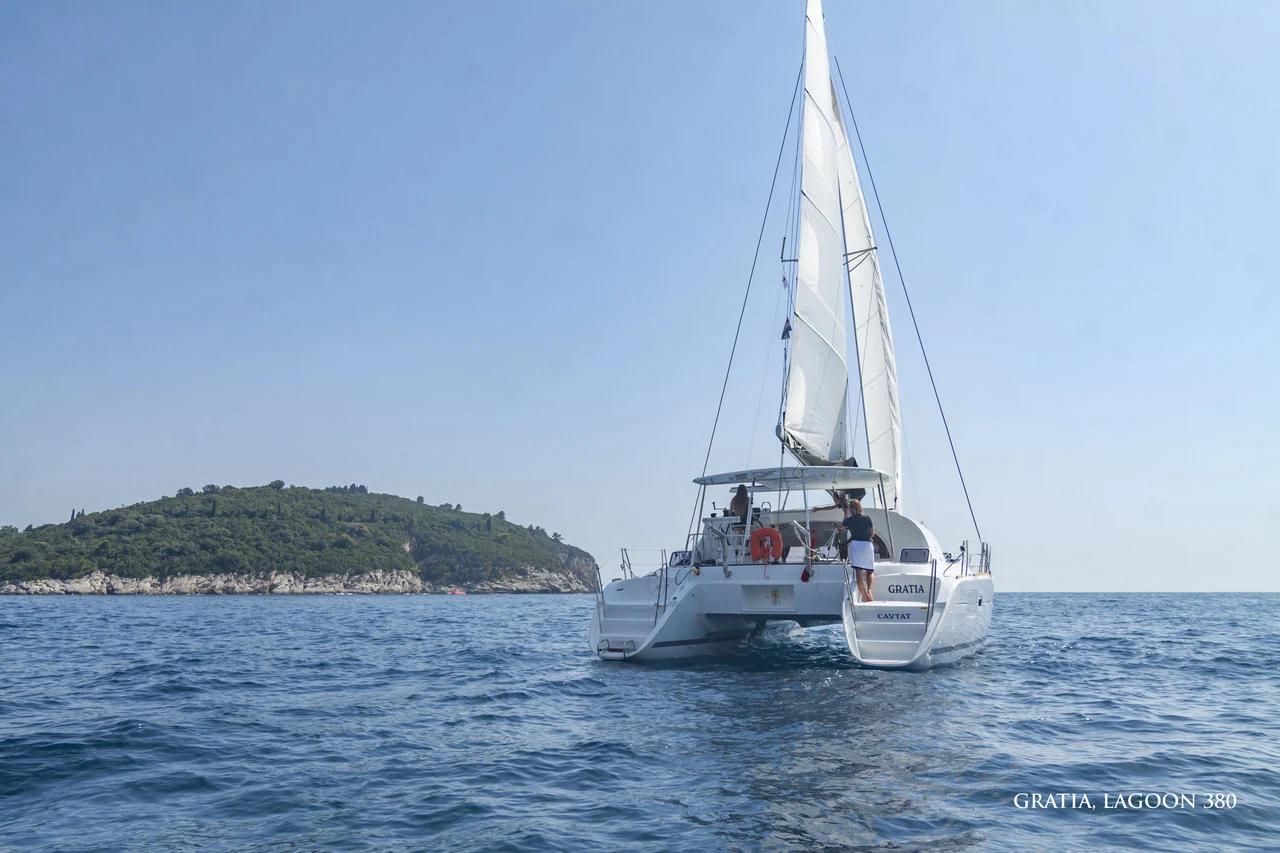
For up to six people, a three-cabin monohull is the cheaper choice: Tonka, an Elan Impression 40.1 from Marina Kaštela, costs €3,875 for a June 2027 week, about €646 each for six. Choose a catamaran for eight or more, or for two families who want cabins in separate hulls and a level saloon, and budget for the extra: most ACI marinas charge a catamaran double, and it burns about 9 litres an engine hour against a monohull's 4.
The sensible comparison uses actual boats for the same week, counts the guest cabins after allowing for a skipper, and includes the costs ashore. The figures below were checked on 30 October 2026.
The choice in practical terms
| Priority | Look closely at a catamaran | Look closely at a monohull |
|---|---|---|
| Separate sleeping areas | Cabins divided between two hulls may suit separate families | Check which cabins share a bathroom or passageway |
| Space together | Compare saloon, cockpit and deck seating for the whole group | Check whether everyone can eat and relax together |
| Bareboat handling | Confirm experience with that beam and engine arrangement | Compare the boat with monohulls you have already handled |
| Overnight costs | Most ACI marinas charge double | Allow €130 to €145 a marina night for about 12 m |
| A hired skipper | Confirm the skipper's agreed sleeping space | Subtract the skipper's accommodation before allocating guest cabins |
Begin with the fleet's individual boat details. Look at layouts, photographs and the full specification together. A boat's advertised maximum capacity can include people sleeping in the saloon. Count cabin and saloon places separately when allocating the group.
Two boats from the same base
The fleet provides a concrete comparison at Marina Kaštela. Tonka is a 2022 Elan Impression 40.1 monohull with three cabins. Maestro is a 2024 Bali 4.6 catamaran with a different size and accommodation plan. They differ in size as well as hull type, so the prices below compare two actual holiday choices.
| Listed detail, checked 30 October 2026 | Tonka, Elan Impression 40.1 | Maestro, Bali 4.6 |
|---|---|---|
| Listed length | 11.99 m | 14.28 m |
| Beam | 3.91 m | 7.66 m |
| Listed draught | 1.8 m | 1.2 m |
| Cabin specification | 3 | 5 + 2 |
| Berth specification | 6 + 2 | 10 + 2 |
| Engine arrangement | One engine | Two engines |
The Bali example has more accommodation and a greater beam, as well as being longer. Its 5 + 2 cabin notation needs a layout inspection: small crew compartments differ from guest cabins in access and facilities. Allocate people to named sleeping spaces so that a numerical berth count does not hide an unsuitable arrangement.
The Bali 4.6 manufacturer's specification gives a hull length of 44 ft 11 in, about 13.69 m. Both boats are therefore under 15 m in hull length. Overall length and model names are different measurements; the registration document supplies the hull length used for the legal assessment.
The sleeping plan before the headcount
Make a named cabin plan before requesting a quotation. Put couples, children and anyone who needs a private cabin into it, then add the skipper if you intend to hire one. Decide whether anybody is willing to sleep in a converted saloon. That decision can change which boat is appropriate without changing the number of guests.
Discuss bathroom access as well as the cabin count. An additional cabin does not necessarily give every couple a separate bathroom. Look at how the accommodation connects and whether people need to pass through a shared area to reach the facilities. A layout drawing is more useful for this than a photograph taken from the widest angle.
Think about the crew during the day too. The table and shaded seating should work for the people aboard. A group that wants long lunches and time at anchor may value a different arrangement from a crew that wants to spend much of the day sailing. Say which kind of week you want before treating extra length as an advantage.
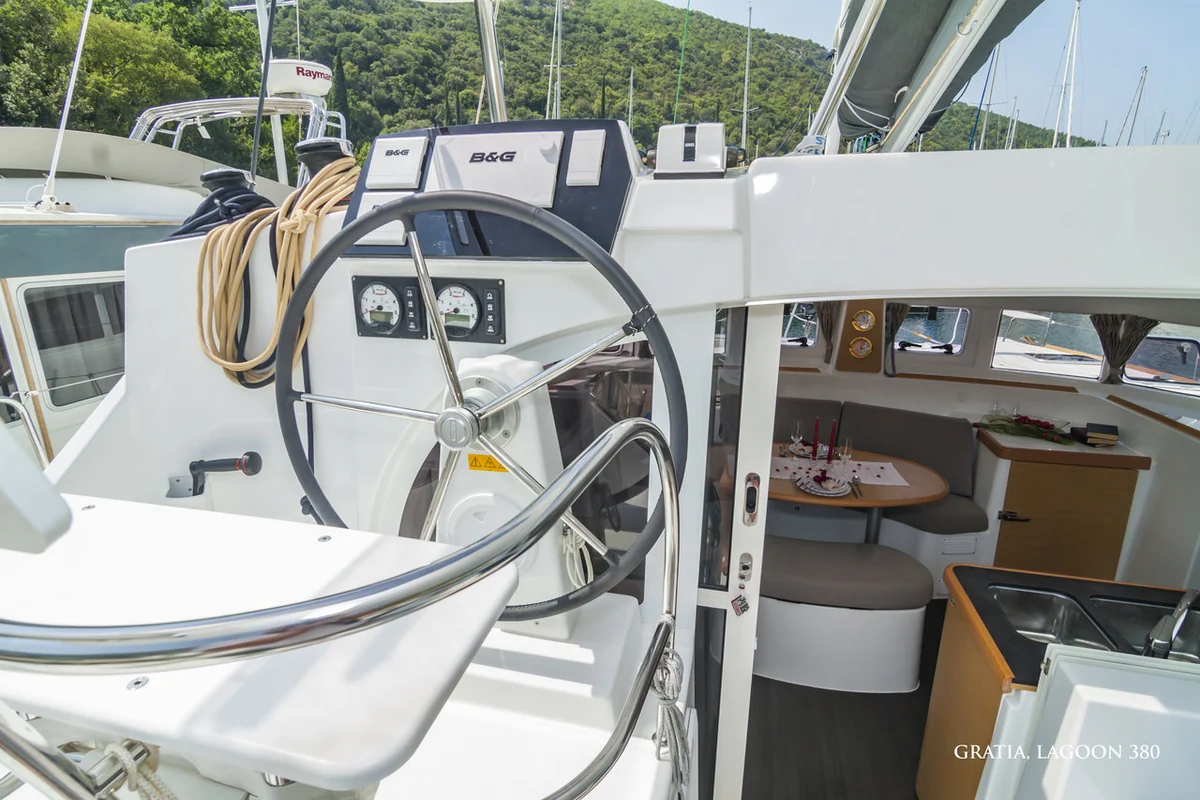
Allow room for everyone during manoeuvres. People who are not handling the boat need a seated position clear of lines, while boarding from a stern-to berth needs a safe route across the gangplank. Include those daily movements in the layout comparison.
Beam, draught and handling
Beam is the boat's width. It matters when arranging a marina berth and when judging how the boat fits into the available manoeuvring space. Send the full dimensions when requesting a berth; a booking described only as a particular length leaves out information the marina needs for a catamaran.
Draught is how far the boat extends below the waterline. The figures in the table describe those particular fleet listings. A shallower listed draught is not permission to ignore the chart, the water level or local restrictions. The skipper still checks the approach, keel or hull clearance, and the conditions at the proposed overnight stop.
Engine arrangement changes the handling you need to understand. The catamaran example has two engines, while the monohull example has one. If you are chartering bareboat, meaning you take responsibility for operating the yacht, tell the base which type and size of boat you have handled before. Ask for a proper briefing on the controls and the particular yacht's equipment.
If the boat is outside your experience, include a professional skipper in the comparison. Extra accommodation is useful only when the chosen yacht and handling arrangement suit the person in charge.
The costs that change with the boat
Ask for both quotations for the same dates and the same intended services. Include the charter, compulsory extras, skipper if required, refundable security deposit arrangements and any optional equipment. Distinguish money you expect to spend from a deposit that may be held and returned under the contract's conditions.
The charter cost calculator uses the following planning figures, checked on 30 October 2026. Its berthing allowances describe a monohull of about 12 m, so they illustrate the difference in charging structure without pretending to quote the larger Maestro.
| Running-cost item | Monohull allowance | Catamaran allowance or treatment |
|---|---|---|
| Transit log, per week | €310 | €400 |
| Marina, July and August | €145 a night | ACI doubles its applicable monohull tariff |
| Marina, other months | €130 a night | ACI doubles its applicable monohull tariff |
| Town quay | €60 a night | Double the applicable monohull charge |
| Fuel use under engine | About 4 litres an hour | About 9 litres an hour with both engines running |
Fuel consumption is an estimate, not a specification for either yacht. The route, engine speed, weather and equipment use affect the bill. Apply the current diesel price to expected engine hours, and leave a reserve. The transit-log allowance is also a budgeting default: use the exact compulsory extras in the quotation before paying.
The marina figures use the 2026 tariff period, which runs to 31 March 2027; a summer 2027 berth needs its new tariff. Town-quay charges vary by port and length. The calculator's double-rate treatment reflects its sourced quay tariff, while its buoy allowance carries no catamaran multiplier. A week of buoys and a week of marinas will therefore produce different comparisons.
Divide a real charter price by a real guest count
For June 2027, the site's weekly fleet prices list Tonka at €3,875 and Maestro at €14,050. Dividing by six people for Tonka gives about €646 each; dividing by ten for Maestro gives €1,405 each. These are yacht-only shares before extras, skipper and running costs. The larger catamaran does not become cheaper per person in this example.
The comparison is not like-for-like: the boats differ in length, age, layout and accommodation. If a hired skipper occupies a guest cabin, use the remaining guest places when dividing the total. Four guests sharing Tonka with a skipper will have a different share from six guests sailing her bareboat.
Licences and the kind of week you want
A licence accepted for these boats can cover either hull type: Croatian licence limits follow the certificate's scope and the boat's hull length, not a separate catamaran category. Both examples are below 15 m. The terms we have reviewed add no separate catamaran qualification. Use the licence checker for your certificate and radio qualification, then assess your handling experience separately. A licence does not demonstrate that you can manoeuvre a 7.66 m beam in a crosswind, and the base may test your ability or require a paid skipper under the charter terms.
Agree on a flexible outline route with the crew. Use the route planner to compare possible overnight stops, then let the skipper adapt the programme to the forecast and berth arrangements. Keep an alternative overnight stop for exposed passages and leave time for the contractual return to the base.
For a smaller crew comparing a monohull from the Split area, Tonka's Elan Impression 40.1 details show the three-cabin arrangement and Marina Kaštela base to check against your own cabin plan.
Frequently asked questions
Is a catamaran better than a monohull for a Croatian charter?
For eight or more people, or two families, yes: separate hulls and a large level saloon are worth the higher price. For up to six, a three-cabin monohull such as Tonka costs less, about €646 each for a June 2027 week. Compare actual layouts and complete quotations for the same dates.
Is a catamaran easier to handle in a marina?
In some ways. Two engines set far apart let a catamaran turn almost on the spot, and it does not heel. Its width works against it: Maestro's 7.66 m beam needs a wider berth, and most ACI marinas charge a catamaran double. Tell the base which boats you have handled, because it may test your ability at sea under the charter terms.
Where does the skipper sleep on a catamaran?
In a crew cabin, if the boat has one. Maestro, a Bali 4.6, lists 5 + 2 cabins: the skipper can take one of the two small crew cabins and leave all five guest cabins free. A three-cabin monohull such as Tonka has no crew cabin, so there the skipper takes a guest cabin.
Can you use the same licence on a catamaran and a monohull?
Yes, where the certificate covers the boat's hull length and operating area and the radio requirement is met. Croatia has no separate catamaran licence category for these examples, and the reviewed charter terms add none. Tonka and Maestro are both below 15 m in hull length. The base can still assess handling ability, including experience with beam and twin engines.
Will a catamaran stop someone getting seasick?
Not always, but it helps. A catamaran heels very little and rolls less at anchor, which many people prone to seasickness find easier. It can still pitch in short, steep seas, so keep passages short on windy days and give anyone affected a seat in the fresh air with a view of the horizon.